All Posts
12 min read
read
What Is Privileged Access Management (PAM)? The Guide for 2026
In 2026, Privileged Access Management (PAM) decides whether a stolen credential stays harmless or becomes a way in. Here is what PAM is, how it works, and what matters for NIS2 and for choosing a solution.

Published
16 Jun 2026
Aktualisiert
25 Sep 2026
Introduction
Anyone talking about IT security in 2026 keeps running into one term: Privileged Access Management, or PAM for short. It covers every method a company uses to control who may access its most critical systems, when that happens, and what takes place during the session. That may sound like a topic for administrators. In reality, it decides whether a single stolen password carries an attacker into the heart of the infrastructure or fails at the very first door.
The pressure rose sharply in 2026. The NIS2 implementation act now applies in Germany, the number of machine and AI-driven identities is growing faster than any team can manage, and cyber insurers demand solid controls over privileged access before they will even offer a policy. This guide explains what PAM is, how it works, and what really matters when you put it in place.
Key Takeaways
- PAM controls and logs access to privileged accounts, the exact credentials that can do the most damage.
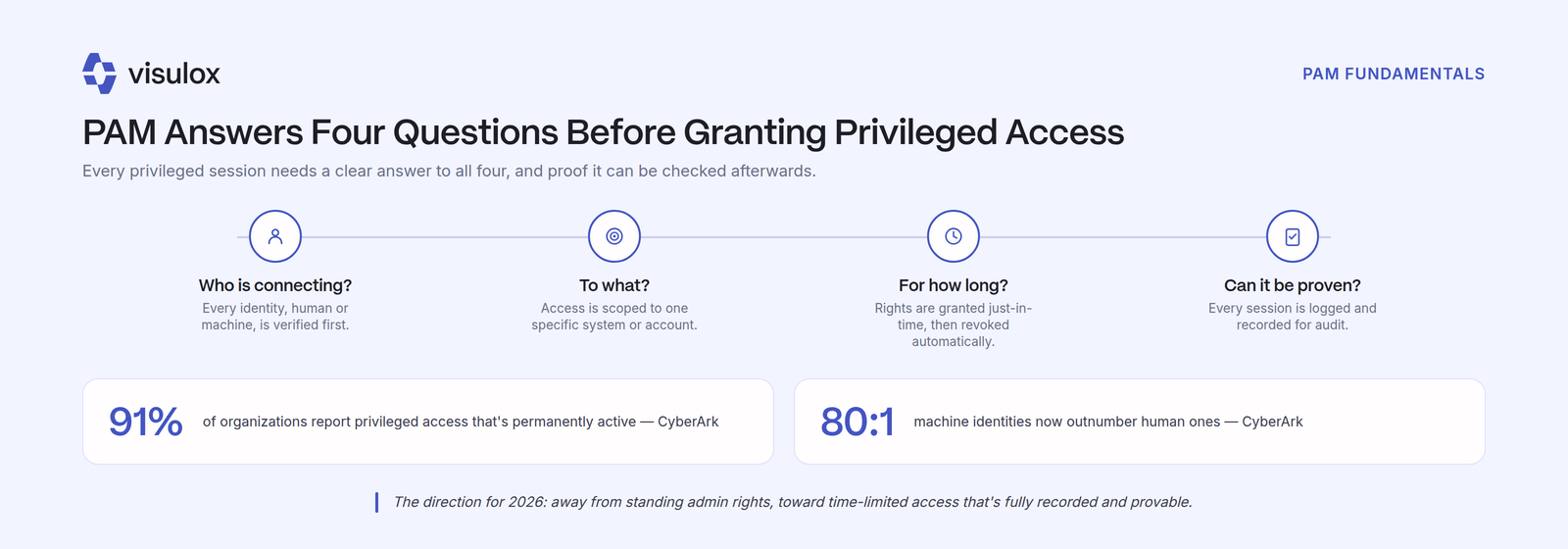
- According to CyberArk, 91 percent of organizations have privileged access that is permanently active. That is precisely what just-in-time approaches aim to end.
- PAM is not the same as IAM. IAM manages who is in the system at all. PAM governs what privileged users are allowed to do.
- NIS2, KRITIS requirements, and GDPR can hardly be met any longer without verifiable access control.
- When choosing a solution, accountability, on-premise operation, and the integration of external service providers matter more than the length of the feature list.
What privileged access management means
Privileged access management brings together all the processes and tools a company uses to secure privileged access. Access is privileged whenever it can do more than a normal user account: configure systems, export data, create other accounts, or switch off security functions. Whoever holds these rights can keep a company running or bring it to a standstill. That is exactly why privileged accounts are the preferred target of attackers.
PAM answers four questions for each of these forms of access: Who is connecting? To what? For how long? And can it all be proven afterwards? For a solid grasp of the fundamentals, see our detailed PAM guide. Closely related is the principle of least privilege, which forms the core idea behind PAM: as few rights as possible, as many as necessary.
Which accounts count as privileged
Many people think first of the domain administrator when privileged accounts come up. The reality is broader. It includes root access on servers, database administrators, application service accounts, cloud root accounts, and the emergency accounts that nobody likes to document. On top of that come the accounts of external service providers who maintain network control systems or IT remotely.
The biggest shift, however, concerns non-human identities. According to CyberArk's Identity Security Landscape Report, machine identities now outnumber human ones by more than 80 to 1, and a substantial share of them hold sensitive or privileged rights. API keys, certificates, and increasingly autonomous AI agents access systems without a human sitting alongside them. Anyone looking to secure third-party access has to treat these accounts exactly like their own. In the KRITIS environment this is especially clear, for example with service provider access at municipal utilities.
How PAM works
A PAM solution consists of several building blocks that interlock.
- A credential vault stores passwords, keys, and certificates centrally and releases them only under control. Nobody knows the actual password anymore.
- Session management establishes the connection to the target system without the credentials ever reaching the user. Every session is recorded and can be followed in real time or cut off immediately if needed.
- Just-in-time access grants rights only when a specific task requires them, and revokes them automatically afterwards. Standing admin rights disappear.
- Logging and auditing record without gaps who did what and when. This is the basis for any compliance review.
Protocol-based access such as RDP is a popular way in. Our article on secure remote desktop access describes how such access can be hardened or replaced.
PAM, IAM, and zero trust: where the lines run
PAM is often confused with identity and access management. The difference is simple: IAM handles who has an identity in the company at all and is allowed to log in. PAM operates one level deeper and governs what privileged users may do with their elevated rights. The two belong together but do not replace one another. We have explained the difference between IAM and PAM in detail in a separate article.
In a modern zero trust architecture, PAM belongs as a central building block. Zero trust assumes that no access is trustworthy from the outset. PAM provides the concrete enforcement for this: every privileged access is checked, time-limited, and recorded. The zero trust approach from VISULOX shows how this can be implemented technically.
Why 2026 marks the end of standing privileges
The figures are sobering. According to CyberArk, 91 percent of organizations report that at least half of their privileged access is permanently active. At the same time, only around one percent have fully implemented just-in-time access. Standing rights are convenient, but they are also an open door: a single compromised account is enough.
The trend for 2026 points clearly in the other direction. Instead of granting rights permanently, they are issued only for the duration of a task and then revoked automatically. The technical term for this is Zero Standing Privileges. The driving force is the explosion of machine and AI identities: 68 percent of respondents say they lack adequate security controls for AI, and half have already experienced security incidents caused by compromised machine identities. How quickly a stolen credential can turn into a total loss is shown by the developments in ransomware.
PAM and compliance: NIS2, KRITIS, and GDPR
Regulation, if nothing else, makes PAM mandatory. The German NIS2 implementation act was promulgated at the end of 2025, and since March 2026 affected companies have had to be registered with the BSI. Around 30,000 organizations in essential and important sectors are affected, generally from 50 employees or 10 million euros in revenue. There is no grace period for the technical measures, and significant incidents must be reported within 24 hours. We summarize what this means in practice in our article on the NIS2 directive.
Without traceable control of privileged access, these requirements can hardly be met. The same applies to GDPR, which demands demonstrable protection of personal data, and to standards such as ISO 27001. Vulnerability management is part of this too: anyone who understands what lies behind a CVE knows that PAM limits the damage as long as a patch is still missing.
What matters when choosing a PAM solution
Vendors' feature lists tend to look alike. The decisive points lie elsewhere. First, accountability: can sessions be recorded in full and evaluated in an audit-proof way? Second, operation: a solution that can be run on-premise keeps control in-house, which carries serious weight in regulated environments and in the matter of digital sovereignty. Third, the integration of external partners, which in practice often represents the biggest point of attack.
This is exactly where VISULOX from amitego comes in. The solution has been developed in Germany for more than 15 years, records privileged sessions in full, securely connects external service providers without a VPN, and can be run on-premise. You can see how VISULOX works in the product overview. It is also important to bring the workforce along: technology alone is not enough, you also need a lived security culture.
Common mistakes during rollout
Three patterns keep coming up. Companies secure their human administrators but forget service accounts and machine identities. They introduce a password vault but skip session recording, so that in an emergency nobody can say what happened. And they treat the remote access of distributed teams as a side issue, even though it has long become the norm. Anyone who factors in these gaps from the start saves themselves expensive fixes later on.
Contact
Your Direct Path to Secure Remote Access
Speak directly with a cybersecurity expert.
Conclusion
In 2026, privileged access management is no longer optional but the foundation of a resilient security strategy. It decides whether a compromised credential stays harmless or becomes a way in. The direction is set: away from standing admin rights and toward time-limited access that is fully recorded and verifiable. Those who start early meet NIS2 and GDPR more easily and noticeably reduce their risk. Our PAM guide for enterprises provides the complete overview.
Frequently Asked Questions
Is PAM mandatory under NIS-2?
NIS-2 does not name privileged access management explicitly, but § 30 BSIG requires access control, multi-factor authentication and audit evidence — requirements that are hard to meet without it. Affected entities must also document who accessed which systems and when. In practice, a PAM solution is the fastest way to cover several obligations at once.
What is the difference between PAM and IAM?
IAM manages every identity in the organisation and decides who may sign in. PAM controls what privileged accounts are allowed to do afterwards — administrators, service accounts and external providers with far-reaching rights. IAM is the breadth, PAM is the depth. They work together: IAM authenticates, PAM authorises, records and time-limits the session.
At what company size does PAM make sense?
Headcount is not the deciding factor; the number of privileged accounts and your regulatory exposure are. A municipal utility with 80 staff and external providers on its grid control technology has a greater need than a software company with 300 employees. Rule of thumb: once external partners hold administrative access, or NIS-2 applies, PAM becomes relevant.
What does privileged access management cost?
Cost depends far more on the licence model than on the list price. The decisive questions are concurrent versus named users, whether sessions are billed separately, and whether cloud operation is mandatory. For the same number of users, annual cost can differ by a factor of two to three between models.
Table Of Content:
Talk to Our Experts
Speak directly with a VISULOX security expert and find out how to protect your infrastructure.
Share:
Lorem ipsum dolor sit amet, consectetur adipiscing elit. Suspendisse varius enim in eros elementum tristique. Duis cursus, mi quis viverra ornare, eros dolor interdum nulla, ut commodo diam libero vitae erat. Aenean faucibus nibh et justo cursus id rutrum lorem imperdiet. Nunc ut sem vitae risus tristique posuere.
Insights on IT Security and Privileged Access
Expert knowledge, practical tips, and the latest trends in PAM, compliance, and secure remote work — straight from the amitego team.