All Posts
6 min read
read
Remote work security: how to protect your workforce from anywhere
Remote Work has permanently changed the attack surface. Here is how to protect distributed teams without slowing down productivity.

Published
05 Mar 2026
Aktualisiert
29 Sep 2026
Introduction
The shift to remote and hybrid work has fundamentally changed the corporate attack surface. Employees who connect from home networks, personal devices, and public Wi-Fi create a dramatic increase in the number of possible entry points for attackers. Security teams need to adapt their strategies accordingly.
Key Takeaways
- Remote Work has dissolved the traditional network boundaries.
- Multi-factor authentication is the single most effective measure for securing remote access.
- SASE architectures offer a modern alternative to traditional VPNs.
- Employee security awareness is critical in a remote-first environment.
The new attack surface
When the workforce moved to home offices, the network perimeter all but dissolved. Every employee's home became an extension of the corporate network, often without the same security controls found in the office. VPNs that once seemed sufficient have turned out to be both a bottleneck and a weak point.
The reason lies in how they work. A VPN grants network access, not system access. Anyone who connects successfully is on the network and can reach, in principle, whatever is reachable there. With a compromised home device, that convenience becomes a direct route into the company.
The biggest threats to remote employees
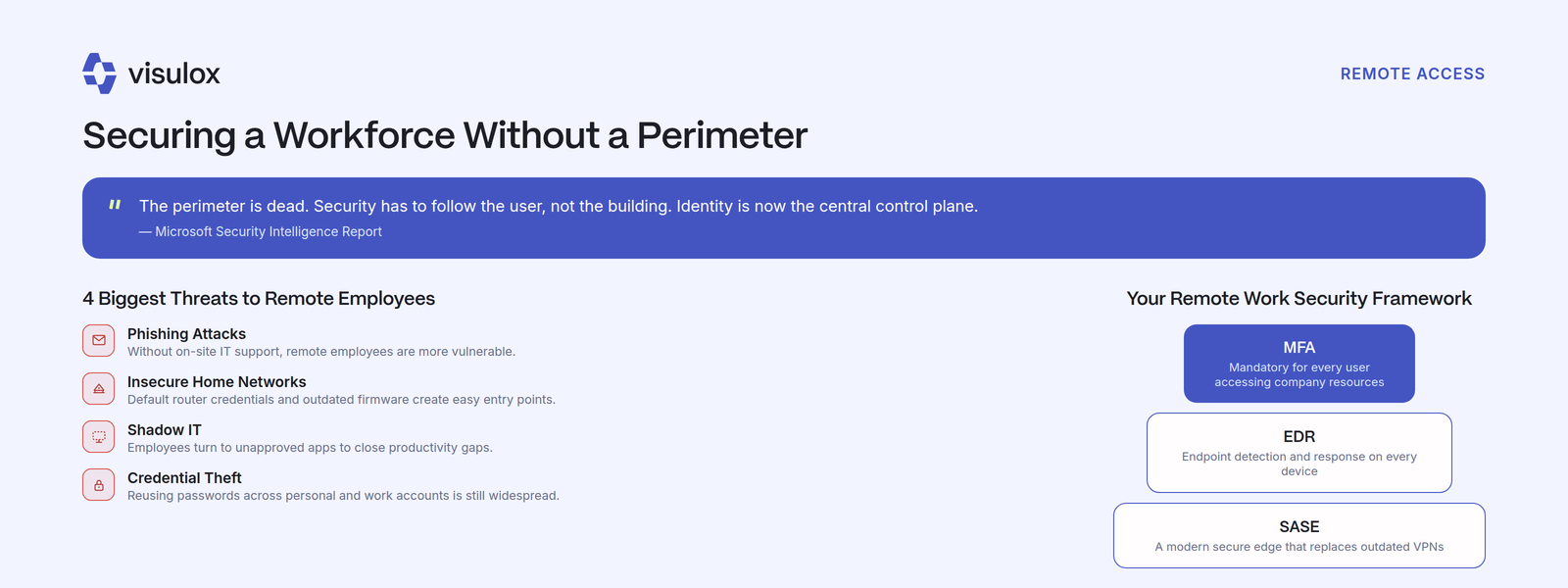
- Phishing attacks: Without on-site IT support, remote employees are more vulnerable. The quick sanity check with the colleague at the next desk disappears, and that second of doubt is the most effective phishing filter there is.
- Insecure home networks: Default router credentials and outdated firmware create easy entry points. The corporate device shares a network with smart TVs, games consoles and everyone else in the household.
- Shadow IT: Employees turn to unapproved apps to close productivity gaps. Shadow IT is rarely malice; it is almost always a symptom. Where the approved route is too cumbersome, a second one appears.
- Credential theft: Reusing passwords across personal and work accounts is still widespread, which turns a breach at any consumer service into a corporate risk.
Building a framework for secure Remote Work
A resilient security strategy for Remote Work starts with identity. Three components carry the model:
- Multi-factor authentication (MFA), mandatory for every user who accesses company resources. It is the single most effective measure because it devalues stolen credentials.
- Endpoint Detection and Response (EDR) on every device, so a compromised endpoint is noticed before it serves as a stepping stone.
- Secure Access Service Edge (SASE) as a modern access architecture in place of outdated VPNs, deciding access per application rather than per network.
That framework is the practical implementation of a Zero Trust architecture: what gets verified is the individual access, not the location.
Where privileged access falls outside the framework
Most remote work programs stop at employee endpoints. Administrators, developers with production access and external service providers also work remotely, though, with far wider rights and often over different routes.
For that group MFA and EDR are not enough. This is where privileged access management comes in: approvals on request, scoping to the individual target system, and gap-free session recording. The target state is zero standing privileges – no permanent admin rights for a compromised home device to inherit.
Why RDP over VPN remains the most common weak point
In practice, administrative remote access often runs over a combination of VPN and Remote Desktop. It is convenient and historically grown, but it combines two weaknesses: network access rather than system access, and a session nobody logs.
How to harden that combination, or better still replace it with a single secure access gateway, is the step with the largest security gain per unit of effort.
People, not just technology
Technical measures only work when the workforce carries them. What matters is less the frequency of training than its shape: short, recurring units demonstrably outperform an annual mandatory session, and a culture where mistakes can be reported without blame measurably shortens response time during a real incident.
Remote work and regulatory requirements
For entities in scope of NIS-2, remote access is no longer a convenience question. The minimum measures under § 30 BSIG require access control, multi-factor authentication and auditability, regardless of whether access comes from the office or from someone's kitchen table. Securing remote work properly satisfies those requirements in the same motion.
Contact
Your Direct Path to Secure Remote Access
Speak directly with a cybersecurity expert.
Conclusion
Remote Work is here to stay, and so are the security challenges it brings. Companies that build security into their remote work strategy from the start, rather than bolting it on afterward, are best positioned to protect their people and their data.
Table Of Content:
Talk to Our Experts
Speak directly with a VISULOX security expert and find out how to protect your infrastructure.
Share:
Lorem ipsum dolor sit amet, consectetur adipiscing elit. Suspendisse varius enim in eros elementum tristique. Duis cursus, mi quis viverra ornare, eros dolor interdum nulla, ut commodo diam libero vitae erat. Aenean faucibus nibh et justo cursus id rutrum lorem imperdiet. Nunc ut sem vitae risus tristique posuere.
Insights on IT Security and Privileged Access
Expert knowledge, practical tips, and the latest trends in PAM, compliance, and secure remote work — straight from the amitego team.