
All Posts
8 min
read
What is PAM? PIM, PAM and IAM explained
PAM, PIM and IAM sound alike but solve different problems. This article defines each term in one sentence, shows the difference in a table, and answers the most common questions about privileged access management.

Published
18 Jun 2026
Aktualisiert
25 Sep 2026
Introduction
Privileged Access Management (PAM) is the software that decides who accesses your most critical systems with elevated rights, and what gets recorded while they do. Two related terms come up around it and are often confused: PIM (Privileged Identity Management) and IAM (Identity and Access Management). The three solve different problems but belong together.
This article answers the three most common questions about them: what privileged access management means, what the difference between PIM and PAM is, and how IAM differs from PAM. Each answer stands on its own, and a comparison table places the terms in context.
Key Takeaways
- Privileged Access Management (PAM) controls, monitors and secures the access of privileged accounts to critical systems. It is the specialized protective layer for an organization's most powerful logins.
- IAM, PIM and PAM are not competitors. They build on each other: IAM manages all identities, PIM manages the privileged ones, and PAM controls what those identities actually do.
- The difference in one sentence: IAM governs access for all users, PAM governs access for the few with elevated rights.
- Privileged accounts are a preferred target for attackers. According to the Verizon Data Breach Investigations Report 2025, stolen credentials were involved in 32 percent of all analyzed breaches.
- Standards such as NIS-2, ISO 27001 and the BSI minimum standards require demonstrable control of privileged access. PAM is the technical answer to that requirement.
What does privileged access management (PAM) mean?
Privileged Access Management (PAM) is a discipline of identity security that controls, monitors and secures the access of privileged accounts to critical systems. Privileged accounts are logins with elevated rights: administrator accounts, service accounts, and the remote access of external service providers.
Such accounts can do almost anything: change configurations, reach sensitive data, delete logs. That is exactly what makes them valuable to attackers. PAM limits this risk through three mechanisms: it grants privileged rights only when needed and only for a limited time (just-in-time), it enforces strong authentication, and it records every privileged session in a traceable way.
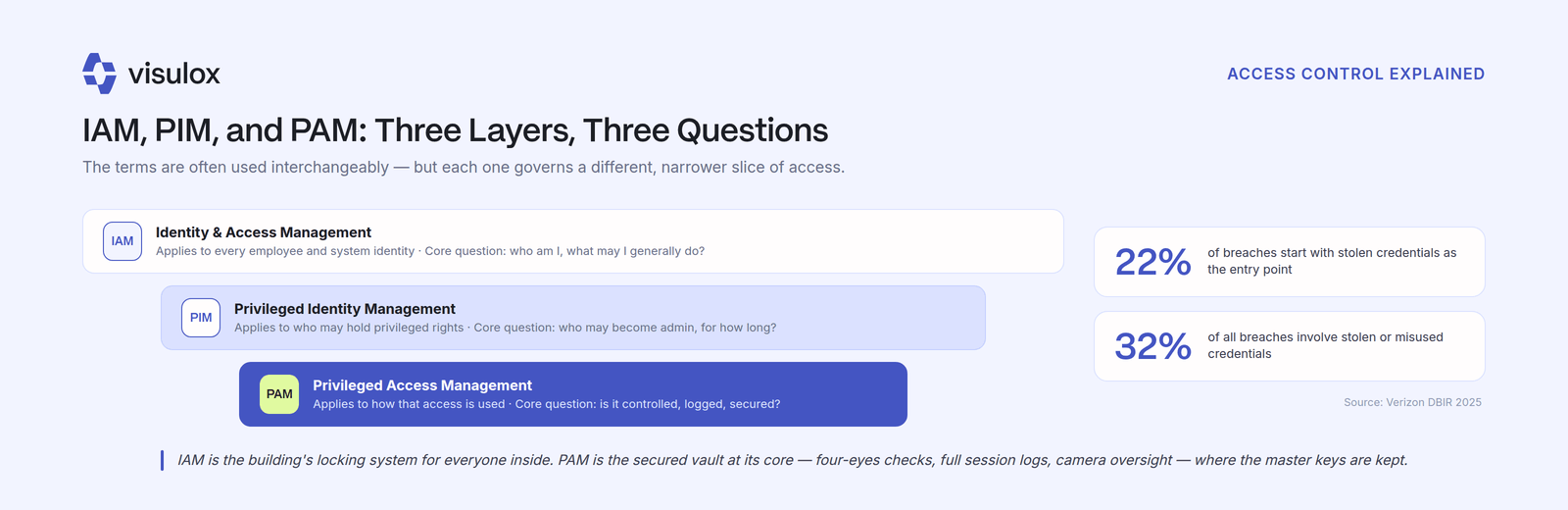
The numbers show why this matters: according to the Verizon Data Breach Investigations Report 2025, stolen credentials served as the entry point in 22 percent of breaches and were involved in 32 percent of all breaches. Whoever takes over a privileged account takes over control. PAM is the layer meant to prevent that.
What is PIM and PAM? The difference
PIM (Privileged Identity Management) manages which identities hold privileged rights. PAM (Privileged Access Management) controls and monitors what those identities actually do with their rights. PIM answers the question „Who may hold elevated rights?", PAM answers the question „How is access with those rights controlled and logged?".
In practice the two work together. PIM defines that a specific person may take on the role of „database administrator", and removes that role again once it is no longer needed. PAM makes sure the person authenticates strongly when using it, accesses only the approved systems, and that every session is recorded.
A note on the terminology confusion: Microsoft uses „PIM" in Entra ID for a feature that governs time-bound role activation. In the wider industry, PIM stands for the management of privileged identities. Both readings point to the same core principle: manage the identity and its permissions before access takes place.
What is the difference between IAM and PAM?
IAM (Identity and Access Management) governs the access of all users in an organization. PAM (Privileged Access Management) is the specialized subdiscipline focused on privileged accounts with elevated rights. IAM is the foundation for every employee, PAM is the additional protective layer for the few especially powerful logins.
An image for it: IAM is the locking system for the entire building and gives each employee access to the right rooms. PAM is the secured vault with four-eyes principle, log and camera, where the master keys are kept. Both belong together, and both have a different job.
Concretely this means: IAM manages sign-in, single sign-on and permissions for everyone. PAM is added where accounts have far-reaching rights, and it adds stricter controls such as time-limited approvals, a password vault for shared accounts, and the complete recording of privileged sessions.
IAM, PIM and PAM at a glance
CriterionIAMPIMPAMStands forIdentity and Access ManagementPrivileged Identity ManagementPrivileged Access ManagementApplies toall users in an organizationprivileged identities onlyprivileged access onlyCore questionWho may sign in and access what?Who may hold elevated rights?How is privileged access controlled and logged?Typical functionssingle sign-on, user management, permissionsrole assignment, time-limited rights, access requestsjust-in-time approval, password vault, session recordingRole in the security modelfoundationmanagement layer above itcontrol and protection layer
The terms overlap because they build on each other. IAM is the base. PIM and PAM sit on top of it and secure the part that can cause the most damage: the privileged accounts.
Who needs PAM and why
Every organization with administrator accounts, service accounts or external provider access has privileged logins that need to be secured. For operators of critical infrastructure and companies within the scope of NIS-2, controlling privileged access is also a regulatory obligation. NIS-2 (implemented through the BSIG in Germany), ISO 27001 and the BSI minimum standards require that privileged access is restricted, monitored and logged in a demonstrable way.
PAM delivers exactly that evidence: who accessed which system, when, and with which rights, traceable down to the individual session. That turns a compliance requirement into a verifiable state. For a deeper start, see our PAM Beginner's Guide.
Frequently asked questions
What does privileged access management mean?
Privileged Access Management (PAM) is an identity security solution that controls, monitors and secures the access of privileged accounts to critical systems. It detects and prevents unauthorized access through accounts with elevated rights.
What is PIM and PAM?
PIM (Privileged Identity Management) manages and secures the identities of privileged accounts. PAM (Privileged Access Management) manages and secures their access to sensitive resources. Both work together, with IAM forming the foundation and PIM and PAM adding further security layers.
What is the difference between IAM and PAM?
IAM provides comprehensive access control for all users in an organization. PAM focuses on privileged accounts with elevated rights. IAM is the foundation, PAM is the specialized protective layer above it.
Is PAM part of IAM?
Yes. PAM is a specialized subdiscipline of IAM. While IAM manages access for all users, PAM specifically secures the privileged accounts.
Who needs a PAM solution?
Every organization with administrator accounts, service accounts or external provider access. For operators of critical infrastructure and companies within the scope of NIS-2, controlling privileged access is mandatory.
Contact
Your Direct Path to Secure Remote Access
Speak directly with a cybersecurity expert.
Conclusion
PAM, PIM and IAM belong together but solve different problems. IAM governs access for all users, PIM manages the privileged identities, and PAM controls and logs what actually happens with privileged rights. Anyone who wants to protect their most critical systems needs all three layers, with particular attention to privileged access. It is the target of most successful attacks. To see what a PAM solution looks like in practice, look at VISULOX: developed in Germany, operated on-premises, with tamper-proof recording of every privileged session.
Frequently Asked Questions
Is PIM the same as PAM?
No. PIM (Privileged Identity Management) manages the privileged identities themselves — which accounts hold elevated rights and how those rights are granted. PAM controls what actually happens during the session: approval, logging, recording and termination. PIM manages the key; PAM watches the door.
Do I still need IAM if I already use PAM?
Yes. PAM covers only the privileged portion, typically a few percent of all accounts. IAM handles the remaining identities, onboarding, revoking rights when someone leaves, and sign-in to business applications. Without IAM most accounts go ungoverned; without PAM the most dangerous ones go uncontrolled.
Does multi-factor authentication belong to IAM or PAM?
To both, at different points. IAM enforces MFA when the identity signs in. PAM requires MFA again when a privileged session starts — precisely when someone is about to use elevated rights. That second check is where a stolen password alone stops being enough.
Where does Zero Trust fit into this?
Zero Trust is a principle rather than a product: no session is trusted permanently. IAM, PIM and PAM are the tools that implement it. PAM provides the concrete enforcement point for privileged access — every session verified individually, time-limited and fully recorded.
Table Of Content:
Talk to Our Experts
Speak directly with a VISULOX security expert and find out how to protect your infrastructure.
Share:
Lorem ipsum dolor sit amet, consectetur adipiscing elit. Suspendisse varius enim in eros elementum tristique. Duis cursus, mi quis viverra ornare, eros dolor interdum nulla, ut commodo diam libero vitae erat. Aenean faucibus nibh et justo cursus id rutrum lorem imperdiet. Nunc ut sem vitae risus tristique posuere.
Insights on IT Security and Privileged Access
Expert knowledge, practical tips, and the latest trends in PAM, compliance, and secure remote work — straight from the amitego team.