
All Posts
7 min read
read
The rise of ransomware: how to protect your business in 2026
Ransomware attacks have changed dramatically. Learn which tactics, techniques, and procedures attackers rely on today, and how to defend against them.

Published
09 Mar 2026
Aktualisiert
29 Sep 2026
Introduction
Ransomware has grown from a nuisance into a criminal industry worth billions. Modern ransomware groups operate as professionally as established software companies. They offer Ransomware-as-a-Service platforms, professional negotiation teams, and even customer support. No business is too small to become a target.
Key Takeaways
- RaaS platforms put ransomware within reach of even low-skilled attackers.
- Double Extortion and Triple Extortion are now standard tactics in ransomware campaigns.
- Immutable, offline backups are the single most effective recovery measure.
- The average total cost of a ransomware attack now exceeds 4.5 million US dollars.
Ransomware-as-a-Service: the new normal
The ransomware ecosystem has become highly professionalized. RaaS platforms let even unskilled attackers deploy sophisticated malware in exchange for a cut of the ransom payment. This has dramatically lowered the barrier to entry and driven the number of attacks sharply upward.
One consequence matters for defenders. The attacker who breaks into your environment is usually not the one who wrote the malware. The division of labor between access brokers, operators and negotiation teams means days or weeks often pass between the initial intrusion and the encryption. That window is your most valuable opportunity.
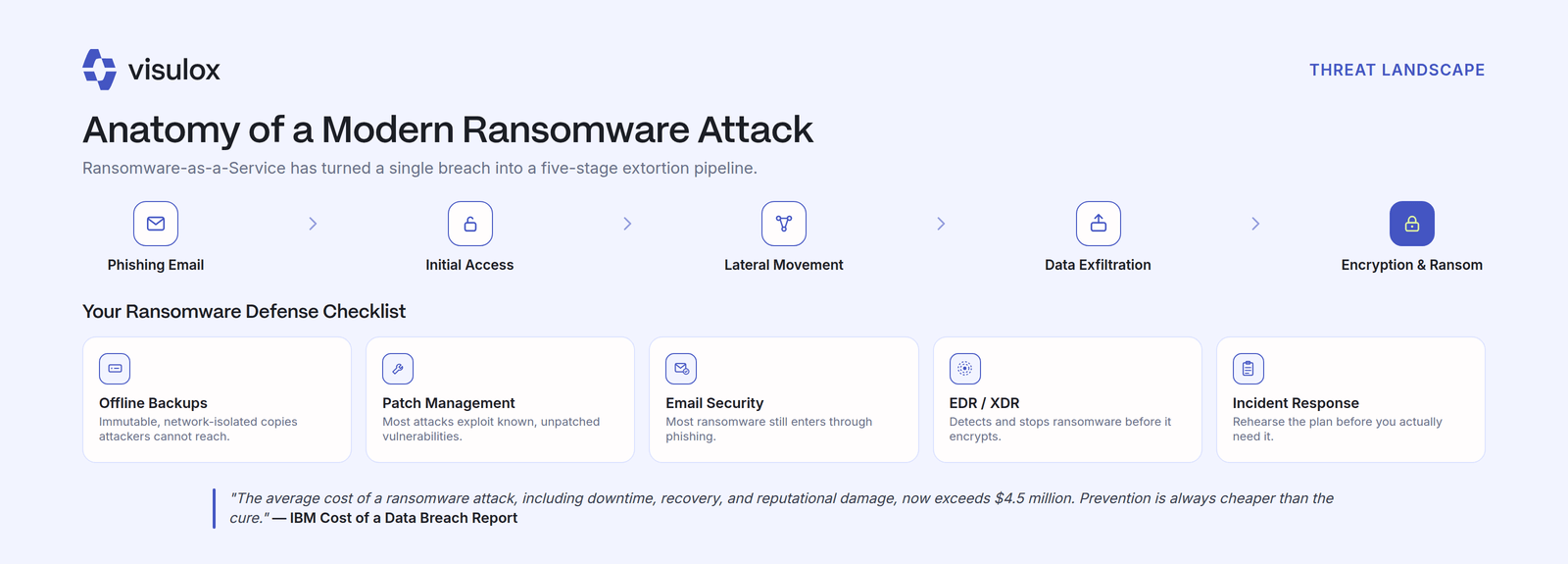
The five stages of a modern attack
Ransomware-as-a-Service turns a single intrusion into a five-stage extortion chain:
- Phishing email: The large majority of ransomware enters the organization through email.
- Initial access: The click becomes a foothold, often through stolen credentials or an unpatched gap.
- Lateral movement: The attacker moves between systems hunting for privileged accounts. Most of the time, and most of the chances to catch them, sit here.
- Data exfiltration: Before anything is encrypted, data is copied out. That copy is the basis for the extortion that follows.
- Encryption and ransom: The visible part of the attack, and also the last.
The key insight: by the time you notice the encryption, the attack has been running for days. A defense that only engages at stage five is damage control, not defense.
Double Extortion and Triple Extortion
Attackers today no longer simply encrypt your data, they steal it first. With Double Extortion, they threaten to publish your sensitive data if you refuse to pay. Triple Extortion adds a third layer: DDoS attacks against your public-facing infrastructure to ramp up the pressure even further.
That shift has an uncomfortable consequence for backup strategy. Backups protect against encryption but not against publication. An organization relying on recoverability alone has solved half the problem. The other half can only be prevented by stopping the exfiltration from happening at all.
Why privileged accounts are the axis of every attack
Between initial access and encryption there is almost always a privileged account. Attackers need elevated rights to move laterally, delete backups and roll out encryption broadly. That is why controlling privileged access is not a side concern but the point where the chain breaks most effectively.
Where no permanent admin rights exist, the hunt for them comes up empty. That is the practical value of zero standing privileges in a ransomware context, and the reason privileged access management appears in every serious defense strategy.
The most common entry points
Three routes dominate in practice. Phishing remains the most frequent first contact. Unpatched, internet-facing services are the second, and an exposed RDP endpoint has been the single most cited case for years. The third route runs through the supply chain: a compromised service provider with remote access to your systems.
The third is underestimated most often, because it sits outside your own department. Regulatorily it does not: NIS-2 treats supply chain security as an obligation in its own right.
Your ransomware defense checklist
- Offline backups: Keep immutable, network-isolated backups that attackers cannot reach. A backup reachable from the production network gets encrypted along with everything else.
- Patch management: Most ransomware attacks exploit known, unpatched vulnerabilities. Prioritize by evidence of active exploitation rather than severity score alone.
- Email security: The majority of all ransomware enters the organization through phishing emails.
- EDR/XDR: Modern endpoint detection can identify and stop ransomware before it encrypts.
- Incident response plan: Rehearse your response before you actually need it. The 24-hour reporting deadline under § 32 BSIG cannot be improvised.
To pay or not to pay
The question looks different in practice than in theory. Payment guarantees neither full recovery nor deletion of the exfiltrated data, and it funds the next wave of attacks. At the same time, executives face enormous pressure when operations have stopped.
The defensible answer is not formed during the incident but before it: an organization with tested backups, a rehearsed response team and reliable logs negotiates from a different position. This article does not constitute legal advice.
Contact
Your Direct Path to Secure Remote Access
Speak directly with a cybersecurity expert.
Conclusion
Ransomware is not a problem you solve once and then check off your list. It demands continuous vigilance, regular testing of backups and incident response plans, and a security culture rooted across the entire organization.
Table Of Content:
Talk to Our Experts
Speak directly with a VISULOX security expert and find out how to protect your infrastructure.
Share:
Lorem ipsum dolor sit amet, consectetur adipiscing elit. Suspendisse varius enim in eros elementum tristique. Duis cursus, mi quis viverra ornare, eros dolor interdum nulla, ut commodo diam libero vitae erat. Aenean faucibus nibh et justo cursus id rutrum lorem imperdiet. Nunc ut sem vitae risus tristique posuere.
Insights on IT Security and Privileged Access
Expert knowledge, practical tips, and the latest trends in PAM, compliance, and secure remote work — straight from the amitego team.