All Posts
9 min read
read
Privileged Access Management: The Complete Enterprise Guide
PAM is one of the most important building blocks of enterprise cybersecurity. This guide explains everything you need to know about protecting privileged accounts.

Published
03 Mar 2026
Aktualisiert
29 Sep 2026
Introduction
Privileged accounts, meaning those with elevated access to critical systems, are among the most frequently targeted resources in any organization. A single compromised administrator account can hand attackers the keys to your entire infrastructure. Privileged Access Management (PAM) is the discipline dedicated to protecting these accounts.
Key Takeaways
- Privileged accounts are the number one target in cyberattacks.
- PAM combines Credential Vaulting, Session-Monitoring, and Just-in-Time access.
- Taking inventory is the decisive first step of any PAM rollout.
- PAM reduces both the likelihood and the impact of a security incident.
What is Privileged Access Management?
PAM refers to the cybersecurity strategies, technologies, and processes used to control, monitor, and protect privileged accounts and credentials across an organization's entire IT environment.
This guide is written for organizations rolling PAM out beyond a single department. If you need the fundamentals first, our article on what privileged access management is explains the concepts from the ground up.
Why privileged accounts are prime targets
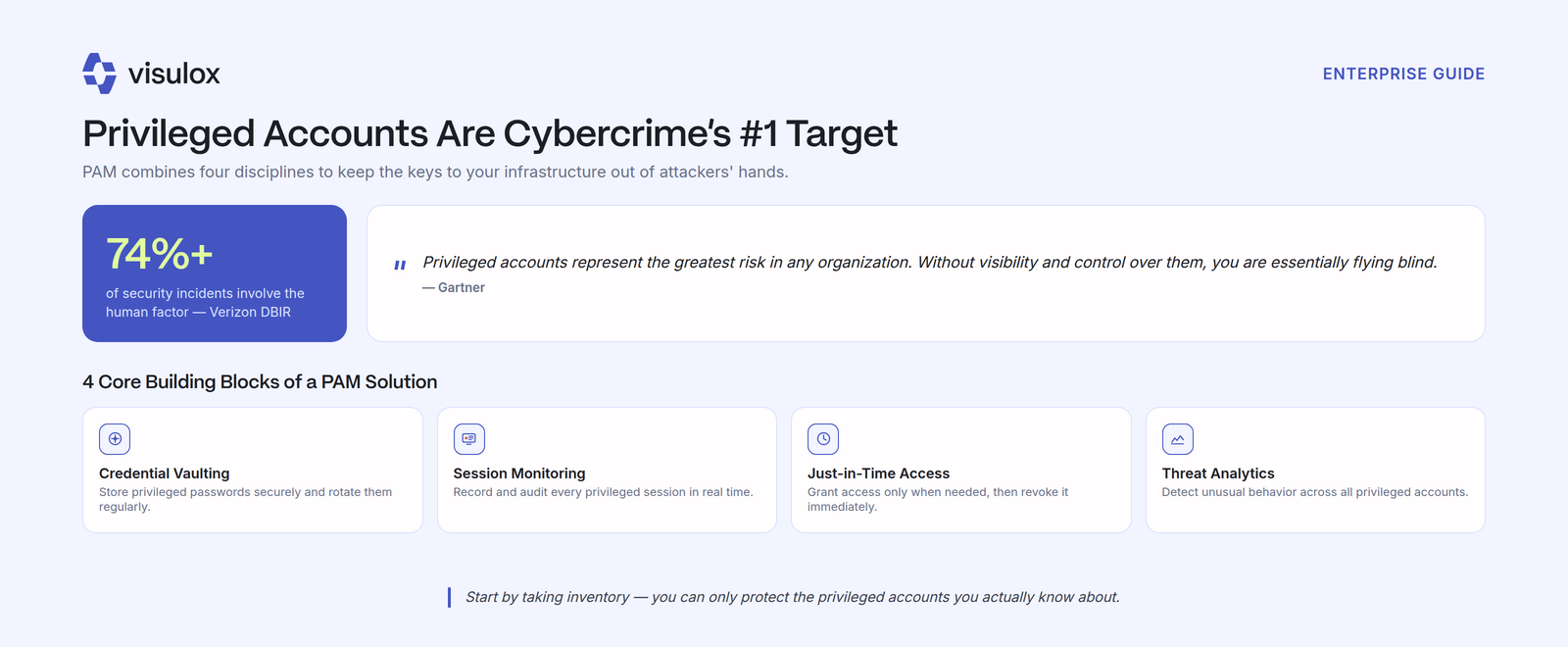
According to Verizon's Data Breach Investigations Report, the human factor is involved in more than 74 percent of all security incidents, and privileged credentials are the most coveted prize of all. Once an attacker gains administrator-level access, they can move laterally across the network, exfiltrate data, and stay undetected for months.
The reason is economic. A privileged account spares the attacker the expensive steps. They do not need to find a vulnerability, escalate privileges, or bypass protective controls; they simply use the paths built for exactly that purpose. It is also why such attacks stay unnoticed so long: they look like ordinary administration.
The core building blocks of a PAM solution
- Credential Vaulting: Store privileged passwords securely and rotate them regularly.
- Session-Monitoring: Record and audit every privileged session in real time.
- Just-in-Time access: Grant access only when it is needed, then revoke it immediately afterward.
- Threat analytics: Detect unusual behavior patterns across all privileged accounts.
The four work together but answer different questions. Vaulting answers where the credentials live. Just-in-time answers when someone may use them. Session monitoring answers what actually happened. Threat analytics answers whether what happened departs from the usual pattern.
The four user groups that belong in scope
PAM projects rarely fail on technology; they fail on scoping. Four groups need different handling:
- Internal administrators: known, present in the directory, comparatively easy to migrate.
- External service providers: the most critical group, because they hold far-reaching rights and are often owned by a different department.
- Developers with production access: frequently overlooked, because their access is treated as a development matter.
- Service and machine accounts: the largest group by number, with no owner and no expiry date.
Securing only the first group covers the most visible population, not the most dangerous one.
Building your PAM roadmap
A successful PAM rollout depends on executive buy-in, a clear inventory of assets, and a phased adoption strategy. Start by taking inventory, because you can only protect what you know about. Most organizations are surprised by just how many privileged accounts actually exist in their environment.
A sequence that works for the first six months:
- Take inventory: which privileged accounts exist, who owns them, when were they last used?
- Service provider access first: the largest share of risk for the smallest disruption to internal operations.
- Turn on session recording: before rights are restructured, so the starting state is documented.
- Remove standing rights: work progressively toward zero standing privileges.
- Machine accounts: as a separate workstream with vaulting and rotation.
Operations: agentless or agent-based
For large environments, whether software has to be installed on target systems is often more decisive than feature count. Agent-based approaches offer deep control but create a rollout project that grows with the number of systems. Agentless approaches place an access point in front of the existing infrastructure and are productive in days rather than months.
In OT environments the choice frequently disappears altogether, because agents on plant controllers are not permitted. The requirements that apply there are covered in our article on remote maintenance under BSI IND.3.2.
PAM in the regulatory context
For entities in scope of NIS-2, PAM pays directly into several of the minimum measures under § 30 BSIG: access control, multi-factor authentication, supply chain security and logging. Art. 32 GDPR demands the same for systems holding personal data, and ISO 27001 through Annex A.
The practical advantage lies in evidence. An entitlement model describes intent; a session recording proves execution. Audits care about the second.
Why PAM projects fail
Three patterns recur. The inventory becomes an end in itself and takes so long that nothing goes live. Approval processes are too slow, so administrators look for ways around them. And service provider access stays out of scope because another department owns it, even though that is exactly where the widest rights sit. What to look for when selecting a platform is summarized in our comparison of current PAM solutions.
Contact
Your Direct Path to Secure Remote Access
Speak directly with a cybersecurity expert.
Conclusion
Adopting PAM is one of the highest-return investments you can make in cybersecurity. It immediately shrinks the attack surface, improves compliance, and gives security teams the visibility they need to respond quickly and decisively to threats.
Table Of Content:
Talk to Our Experts
Speak directly with a VISULOX security expert and find out how to protect your infrastructure.
Share:
Lorem ipsum dolor sit amet, consectetur adipiscing elit. Suspendisse varius enim in eros elementum tristique. Duis cursus, mi quis viverra ornare, eros dolor interdum nulla, ut commodo diam libero vitae erat. Aenean faucibus nibh et justo cursus id rutrum lorem imperdiet. Nunc ut sem vitae risus tristique posuere.
Insights on IT Security and Privileged Access
Expert knowledge, practical tips, and the latest trends in PAM, compliance, and secure remote work — straight from the amitego team.