All Posts
5 min read
read
The principle of least privilege: the foundation of modern security
Least Privilege is one of the most effective security measures, yet it is rarely applied consistently. Here is how to put it to work.

Published
11 Mar 2026
Aktualisiert
29 Sep 2026
Introduction
The Principle of Least Privilege (PoLP) holds that every user, application, and system should have access only to the resources needed to perform a given task, and nothing more. The idea is simple, but in enterprise environments it ranks among the least consistently implemented security measures.
Key Takeaways
- Most organizations carry significant, often unnoticed privilege sprawl.
- Just-in-Time access is considered the gold standard for managing privileged accounts.
- Regular access reviews are essential to sustain Least Privilege over time.
- Service accounts often hold the most permissions while being the most likely to go overlooked.
Why over-privileged accounts are everywhere
In most organizations, permissions accumulate over time. A user is granted administrator rights to solve a one-off problem. A service account is given broad rights for the sake of convenience. No one removes the access once it is no longer needed. The result is a sprawling, invisible risk that attackers deliberately exploit.
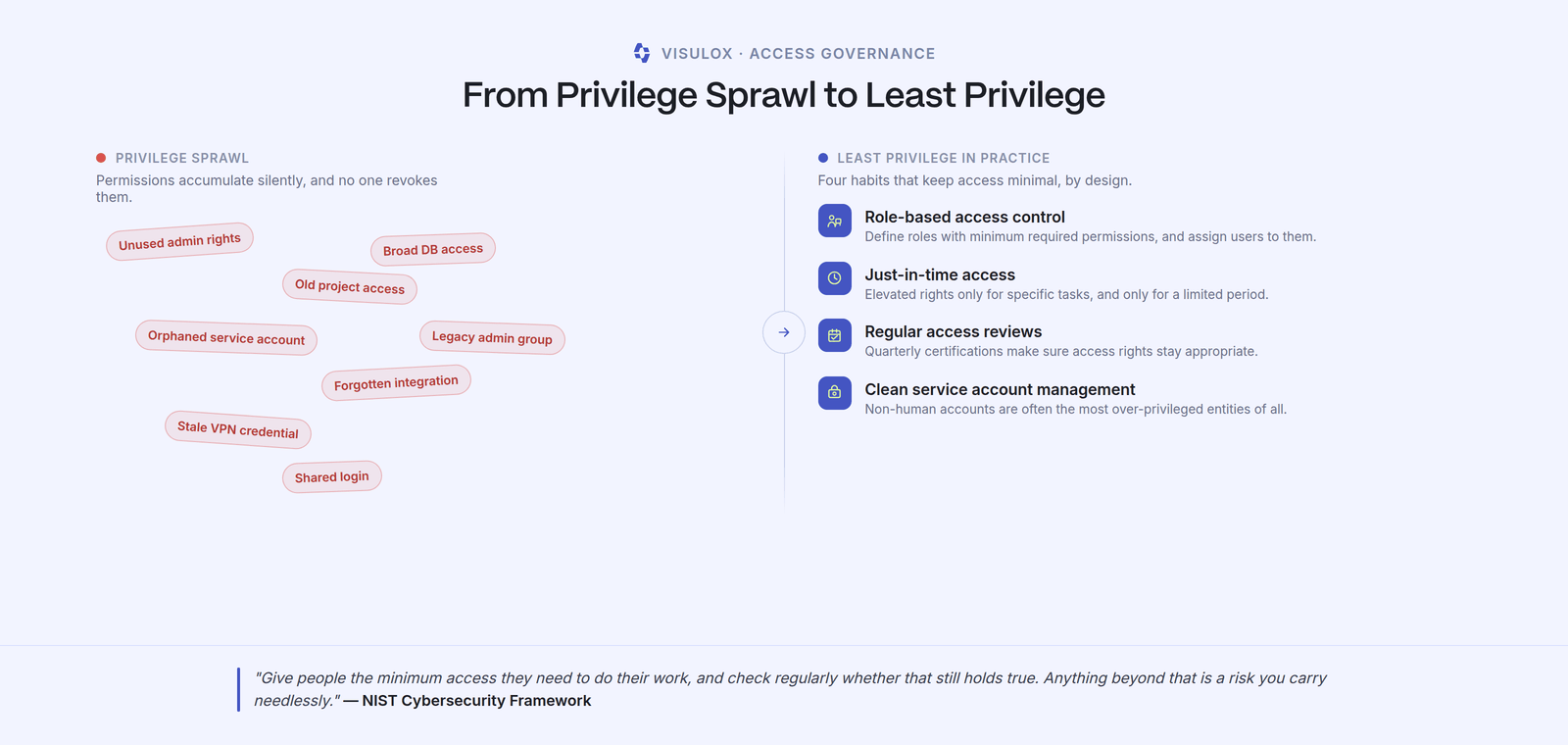
Privilege sprawl rarely comes from one bad decision. It comes from many small ones, each defensible on its own. In environments that have grown over years you will typically find:
- unused admin rights left over from a project that closed long ago
- broad database access granted for a single one-off analysis
- stale project access belonging to people who changed departments
- orphaned service accounts with no identifiable owner
- old admin groups whose membership nobody reviews any more
- forgotten integrations holding permanently valid credentials
- outdated VPN credentials belonging to former service providers
- shared logins masking several individual people
Each item is harmless on its own. Together they form the attack surface that turns one compromised account into access across the network.
What least privilege actually means
The principle requires every identity to hold exactly the rights its task demands, and to hold them only while the task runs. Two dimensions matter here, and they are routinely conflated.
Scope describes what an account may reach: one system rather than a whole network segment, one database rather than the entire server. Duration describes how long it may do so. Many organizations optimize scope alone and leave duration open-ended. That is where the risk survives, because a precisely scoped right that never expires is exposed around the clock.
Least Privilege in practice
- Role-based access control (RBAC): Define roles with the minimum permissions required and assign users to those roles. The most common mistake is deriving roles from existing permissions, which cements the sprawl instead of reducing it.
- Just-in-Time access: Grant elevated rights only for specific tasks and for a limited period. What matters is that requesting and approving take seconds; where approval becomes a bottleneck, administrators route around it.
- Regular access reviews: Quarterly certifications keep access rights appropriate. They only work when the reviewer understands the business context. Sign-off by IT with no domain knowledge is a signature without meaning.
- Clean service account management: Non-human accounts are often the most over-privileged entities in an environment. Every service account needs a named owner and a documented expiry date.
Making privilege sprawl visible
Rights cannot be reduced until they are known. Three queries usually produce a reliable picture quickly. Which accounts hold administrative rights without having used them in the last 90 days? Which accounts belong to people who have left the company or the department? And which access paths still exist for providers whose contract has ended?
Those three questions tend to surface the bulk of the critical legacy, and they can be answered without first building a complete entitlement model.
Least privilege for service and machine accounts
For interactive human access, least privilege is comparatively straightforward. Machine accounts are harder: they run unattended, their credentials often sit in scripts or configuration files, and an expired password can halt a process outright.
The way through is short-lived tokens or a credential vault that rotates secrets and never exposes them in clear text. The principle stays the same; the technical implementation differs enough that machine accounts deserve their own workstream in any least-privilege project.
Least privilege and zero standing privileges
The two terms are often used interchangeably, but they describe different levels of ambition. Least privilege limits what an account may do. Zero standing privileges goes further and removes elevated rights at rest entirely.
In practice: least privilege is the principle, zero standing privileges is the target state, and just-in-time is the mechanism that produces it. Both are components of a Zero Trust architecture.
The role of PAM in enforcing Least Privilege
Privileged Access Management solutions are purpose-built to enforce Least Privilege even at scale. By centralizing credential management, providing Just-in-Time access, and delivering complete audit logs of sessions, PAM makes Least Privilege practical even in large and complex environments.
The decisive difference from entitlement management alone is evidence. An entitlement model describes what would be permitted. A session recording proves what actually happened. Audits care about the second. What to look for when selecting a platform is set out in our comparison of current PAM solutions.
Least privilege in the regulatory context
Least privilege is not optional polish. The minimum measures under § 30 BSIG, Germany's implementation of NIS-2, explicitly require access control concepts, ISO 27001 demands the same through Annex A, and the BSI minimum standards describe it as a baseline requirement. Limiting rights consistently, and being able to document it, satisfies several obligations at once.
Common implementation mistakes
Three patterns show up in almost every failed project. First, teams start with a complete inventory that takes so long nothing ever gets implemented. Second, roles are derived from the current state, which permanently enshrines existing over-entitlement. Third, provider access is left out of scope because it sits organizationally with another department, even though that is precisely where the widest rights are granted.
Contact
Your Direct Path to Secure Remote Access
Speak directly with a cybersecurity expert.
Conclusion
Least Privilege is not a one-time configuration. It calls for ongoing governance, automated tooling, and a culture that treats access as a risk to be minimized rather than a convenience to be maximized. Organizations that get this right substantially reduce their attack surface against insider threats as well as external attackers.
Table Of Content:
Talk to Our Experts
Speak directly with a VISULOX security expert and find out how to protect your infrastructure.
Share:
Lorem ipsum dolor sit amet, consectetur adipiscing elit. Suspendisse varius enim in eros elementum tristique. Duis cursus, mi quis viverra ornare, eros dolor interdum nulla, ut commodo diam libero vitae erat. Aenean faucibus nibh et justo cursus id rutrum lorem imperdiet. Nunc ut sem vitae risus tristique posuere.
Insights on IT Security and Privileged Access
Expert knowledge, practical tips, and the latest trends in PAM, compliance, and secure remote work — straight from the amitego team.