All Posts
6 min read
read
IAM vs. PAM: The difference, and why you need both
IAM and PAM are often confused. Here is how they differ, and why a complete security strategy needs both.

Published
17 Mar 2026
Aktualisiert
29 Sep 2026
Introduction
Identity and Access Management (IAM) and Privileged Access Management (PAM) are among the core pillars of modern cybersecurity. They are often mentioned in the same breath, and they are often confused with each other. Yet they are neither the same thing nor competitors.
Understanding the difference is not an academic exercise. It is a prerequisite for a complete access security strategy, because relying on just one of the two disciplines leaves dangerous gaps open.
IAM answers the question: Who has access, and to what? PAM goes a step further and asks: How do we control and monitor the most powerful forms of access in the system? Both questions are essential. Neither replaces the other.
Key Takeaways
IAM manages all digital identities in the organization: employees, partners, and systems.
PAM is the specialization for privileged accounts (admins, root access, service accounts) that carry especially high risk.
The distinction: IAM answers "Who are you and what are you generally allowed to do?" PAM answers "How exactly do we monitor and control your most powerful access?"
The two complement each other: IAM creates the foundation, and PAM adds the depth of control that high-risk accounts require, including session recording, just-in-time access, password vaulting, and granular auditing.
What is IAM?
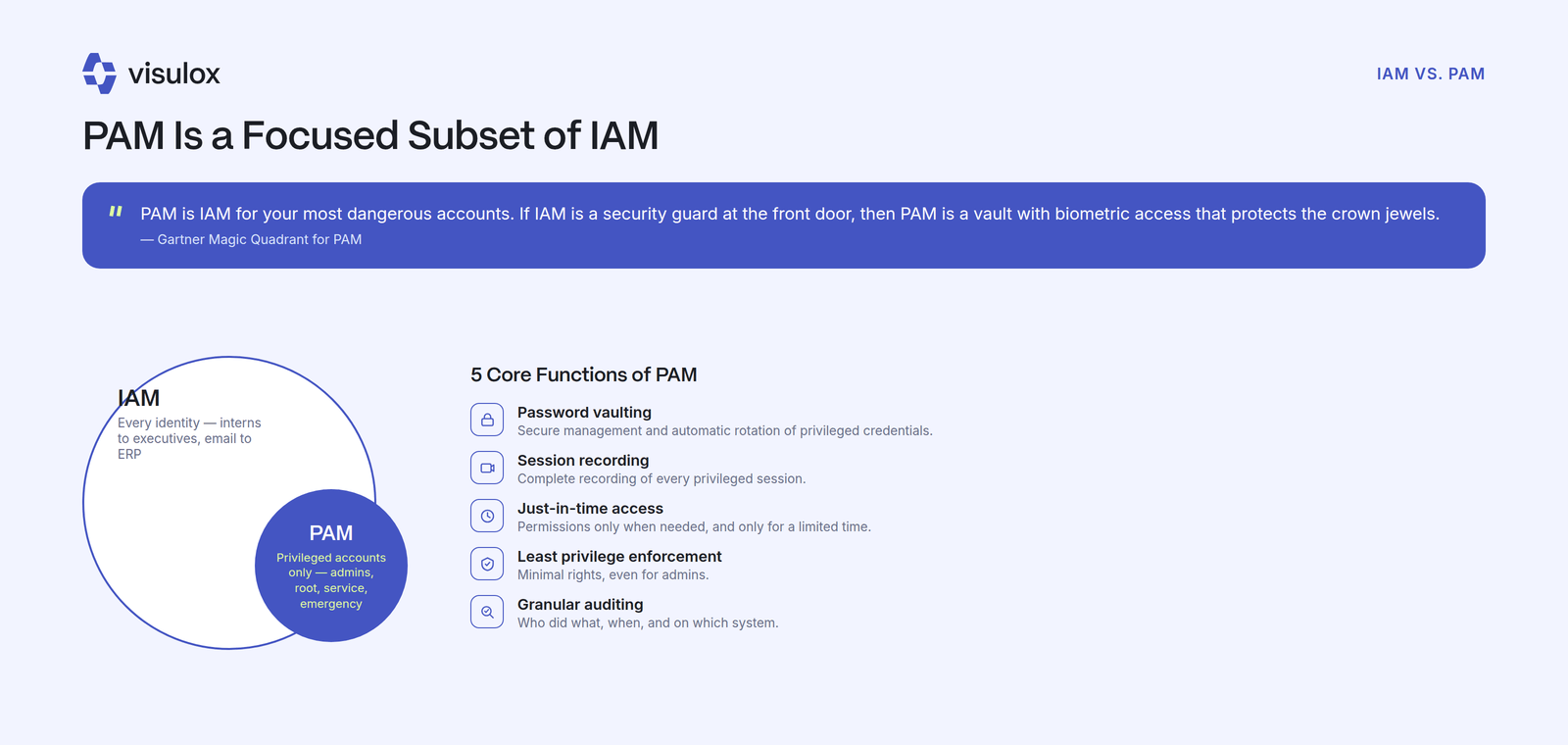
IAM covers the policies, processes, and technologies that manage digital identities and govern access to resources. It answers the question: Who is this person, and what are they allowed to access? IAM applies to every user in the organization, from interns to the executive level, and to every system, from email to ERP.
Typical IAM functions include single sign-on, managing the user lifecycle from joining to leaving, assigning roles and entitlements, and connecting business applications. IAM is therefore mainly a question of breadth: many identities, many systems, one consistent way of administering them.
What is PAM?
PAM is a subset of IAM that focuses exclusively on privileged accounts, meaning accounts with elevated permissions that grant access to sensitive systems and data. Where IAM manages the entire workforce, PAM takes care of the most powerful accounts: domain admins, root accounts, service accounts, and emergency access.
An image that captures the division of labor: IAM is the security desk at the front door, checking who may enter the building. PAM is the vault inside, with its own access control, log and camera for the few who need to go in.
Core functions of PAM
- Password vaulting: Secure management and automatic rotation of privileged credentials
- Session recording: Complete recording of privileged sessions
- Just-in-time access: Permissions only when needed, and only for a limited time
- Least privilege enforcement: Minimal rights, even for admins
- Granular auditing: Who did what, when, and on which system?
The difference in practice
The distinction becomes concrete once you look at the same situation through both lenses. An employee moves to another department: that is an IAM operation, withdrawing old roles and granting new ones. An administrator opens a session on the finance database server: that is a PAM operation, checking the approval, scoping the session, starting the recording.
The second difference is the time axis. IAM decisions hold until somebody changes them. PAM decisions hold for one session. That is precisely why well-maintained IAM alone is not sufficient: it records who is allowed to be an administrator, but not what actually happened inside any given administrative session.
Where IAM alone leaves gaps
Three gaps show up repeatedly when organizations rely on IAM by itself.
Shared accounts: An administrator account used by several people can be managed through IAM but cannot be attributed to a named individual. In an audit, that attribution is exactly the question being asked.
External service providers: They frequently sit outside the central directory yet connect with far-reaching rights. Often IAM does not know they exist.
Missing session evidence: IAM logs sign-ins, not actions. For NIS-2 and Art. 32 GDPR, though, the action is the evidence.
Do I need both, and in what order?
In most organizations IAM already exists and PAM does not. The pragmatic sequence is therefore to keep IAM stable as the foundation and add PAM where the rights reach furthest, typically administrators and external service providers.
Starting entirely from scratch, you still do well to secure privileged access first. One uncontrolled admin account causes more damage than a hundred poorly maintained user accounts. Which criteria matter when selecting a platform is set out in our comparison of current PAM solutions.
And where does PIM fit in?
A third term often appears alongside IAM and PAM: Privileged Identity Management. PIM governs which identities may hold privileged rights; PAM controls what happens with those rights. The terms overlap considerably depending on the vendor, and a fuller separation is available in PAM, PIM and IAM compared.
How the two work together
The two disciplines work best when PAM connects to the existing identity system rather than building a second user directory. Through SAML or OAuth, identity stays centrally maintained while the privileged session is additionally verified, scoped and recorded.
Together they form the enforcement points of a Zero Trust architecture: IAM establishes who someone is, PAM decides again at every individual privileged access.
Contact
Your Direct Path to Secure Remote Access
Speak directly with a cybersecurity expert.
Conclusion
IAM secures the front door; PAM secures the vault. Anyone who uses only one of the two leaves gaps that professional attackers will deliberately exploit. A complete access security strategy needs both: the breadth of IAM and the depth of PAM.
Table Of Content:
Talk to Our Experts
Speak directly with a VISULOX security expert and find out how to protect your infrastructure.
Share:
Lorem ipsum dolor sit amet, consectetur adipiscing elit. Suspendisse varius enim in eros elementum tristique. Duis cursus, mi quis viverra ornare, eros dolor interdum nulla, ut commodo diam libero vitae erat. Aenean faucibus nibh et justo cursus id rutrum lorem imperdiet. Nunc ut sem vitae risus tristique posuere.
Insights on IT Security and Privileged Access
Expert knowledge, practical tips, and the latest trends in PAM, compliance, and secure remote work — straight from the amitego team.