All Posts
8 min read
read
GDPR Compliance in 2026: What Every Organization Must Know
GDPR is being enforced more strictly than ever before. Stay ahead of regulatory requirements and avoid costly fines with this up-to-date compliance guide.

Published
07 Mar 2026
Aktualisiert
29 Sep 2026
Introduction
Since it took effect in 2018, the GDPR has fundamentally changed how organizations handle personal data. With fines now landing regularly in the hundreds of millions and enforcement growing tougher, compliance is no longer optional. It is essential.
Key Takeaways
- GDPR fines surpassed 3.5 billion euros in 2025, and enforcement is gaining momentum.
- Technical measures must be implemented, not merely documented.
- The 72-hour breach notification rule is being enforced consistently.
- Privacy by design must be embedded in every new system and process.
The state of GDPR enforcement in 2026
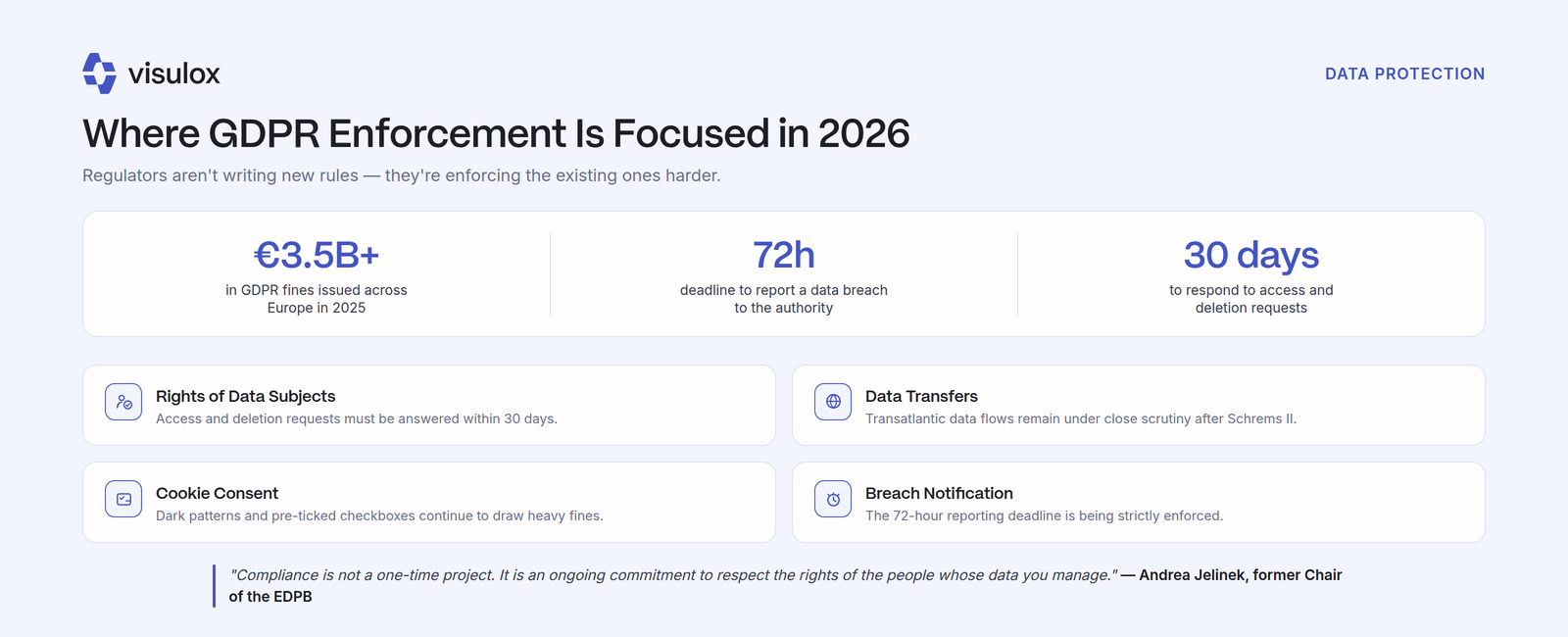
Supervisory authorities across Europe have stepped up their enforcement activity significantly. In 2025 alone, the total value of fines issued under the GDPR exceeded 3.5 billion euros. The message from regulators is clear: technical and organizational measures must be put into practice, not simply written down.
What is notable is less the size of the number than the shift in what gets examined. Findings increasingly concern not a missing policy but the gap between policy and practice: an entitlement model nobody enforces, or logging from which nothing can be reconstructed when it matters.
The three deadlines that matter in practice
Three timeframes decide whether a data protection incident stays manageable:
- 72 hours to report a breach to the supervisory authority under Art. 33 GDPR.
- 30 days to answer access and deletion requests from data subjects.
- Without undue delay to notify the data subjects themselves where there is a high risk to their rights.
The 72-hour deadline is the hardest, because it runs from awareness rather than from full understanding of the facts. An organization that only starts clarifying responsibilities at that point has already lost the window.
Key areas of focus for regulators
- Rights of data subjects: Organizations must respond to access and deletion requests within 30 days. That presupposes knowing where personal data actually sits.
- Data transfers: In the wake of Schrems II, transatlantic data flows remain under close scrutiny. What decides the question is not the server location alone but which legal system the provider is subject to.
- Cookie consent: Dark patterns and pre-ticked checkboxes continue to draw heavy fines.
- Breach notification: The 72-hour reporting deadline is being strictly enforced.
Art. 32 GDPR: the article that governs access
In public perception the GDPR is about consent and cookie banners. In audits it is more often about Art. 32: the duty to implement appropriate technical and organizational measures. Those explicitly include access control, confidentiality, and the ability to test the effectiveness of those measures regularly.
In practice that means anyone with administrative access to systems holding personal data needs to be controlled and logged. That is where privileged access management reaches from IT into data protection, and why the principle of least privilege appears in every credible data protection concept.
Processors and external service providers
Any provider with remote access to systems containing personal data is relevant under data protection law, regardless of whether they are meant to process the data or merely can reach it technically. A maintenance path into a database server is an access capability, and Art. 28 requires a processing agreement for it.
More common than a missing contract, though, is missing control: a permanently open path with no time limit and no record of what happened during the session. How to resolve that technically is covered in our piece on zero standing privileges.
GDPR and NIS-2: two regimes, one implementation
Many organizations work these two topics separately, even though the requirements overlap at the decisive point. Access control, multi-factor authentication, logging and supply chain security are demanded by both Art. 32 GDPR and § 30 BSIG, Germany's implementation of NIS-2.
The reporting deadlines are similar too: 72 hours under the GDPR, 24 hours for the early warning under § 32 BSIG. Building one shared notification process rather than two parallel ones saves effort and avoids contradictory statements to different authorities.
Building a culture that puts compliance first
The organizations that fare best in GDPR audits are those that treat data protection as a core business value rather than a legal obligation. That means appointing a dedicated data protection officer, carrying out regular data protection impact assessments, and building privacy by design into every new product and process.
This article does not constitute legal advice.
Contact
Your Direct Path to Secure Remote Access
Speak directly with a cybersecurity expert.
Conclusion
GDPR compliance is an ongoing process, not a state you reach once and forget. Organizations that invest in solid data protection frameworks, employee training, and technical controls are far better placed to avoid fines and earn the trust of their customers.
Table Of Content:
Talk to Our Experts
Speak directly with a VISULOX security expert and find out how to protect your infrastructure.
Share:
Lorem ipsum dolor sit amet, consectetur adipiscing elit. Suspendisse varius enim in eros elementum tristique. Duis cursus, mi quis viverra ornare, eros dolor interdum nulla, ut commodo diam libero vitae erat. Aenean faucibus nibh et justo cursus id rutrum lorem imperdiet. Nunc ut sem vitae risus tristique posuere.
Insights on IT Security and Privileged Access
Expert knowledge, practical tips, and the latest trends in PAM, compliance, and secure remote work — straight from the amitego team.